Wow…you have come this far! I hope you have had success using the last two databases – Part 1 and Part 2 – and cannot wait to learn how to progress further!
Please read on…
General Register database
The General Register of Indians in Fiji is another useful resource. Within the register, you will find details such as where in Fiji they went, who they married, whether and when they returned to India, death date, etc.
Within the register are 9 books, organised according to ship arrivals and emigration pass numbers. Each book title lists the passes contained within that book. For example, to search for pass number 1712, search within Book 1, which contains information about pass numbers 1 to 12281.
Each person or pass number has two pages of information – see images below.
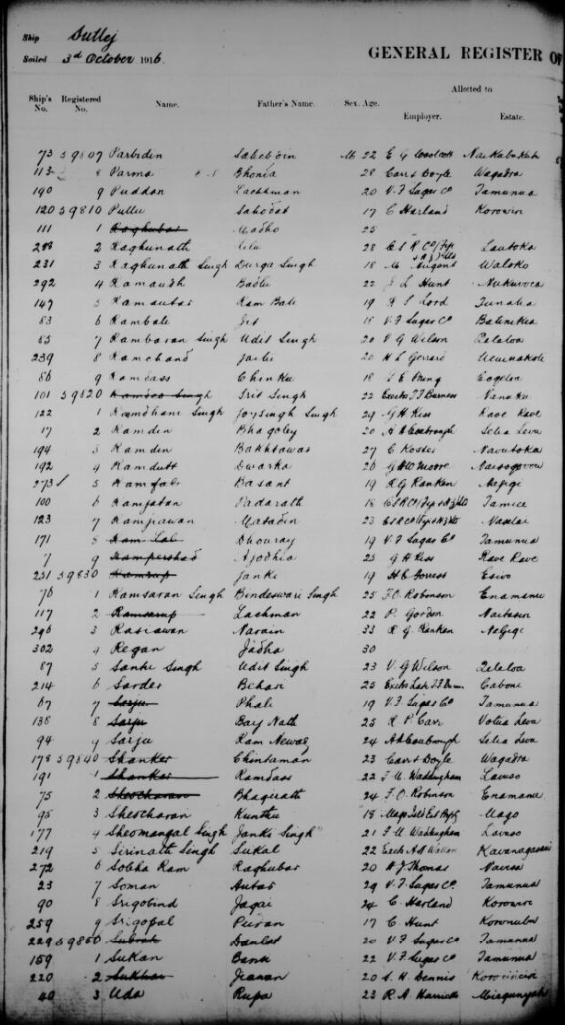

Migrants’ pass number, father’s name, age, sex (from their emigration passes), and location in Fiji are on the first page. On the second page, there’s information pertaining to their marriage records, death, etc. The red circles on the above image show the marriage records. There are no names, just pass numbers of spouses.
The second page was very useful in all my ancestry searches. For example, I knew the names of both great grandparents from my maternal grandmother’s side. The General Register records validated that they married each other.
Hints
If you know the name of one ancestor, this register can help you find the other. For example, to find GGF#2, looking up the records of GGM#2 in the General register revealed which pass number she got married to. I found GGF#2’s emigration pass number in this register.
The only drawback of this database is that all records are on Microfilm, and people’s details are handwritten. Therefore, there are obvious challenges with deciphering the handwriting. Additionally, if the microfilm is of poor quality, you cannot get much information.
At the end of each search, my eyes and head hurt. It is hard work…reading pages and pages of information. Take lots of breaks, but do not give up. The pain is worth it.
Moreover, if you do not know where to look, going through this database may feel like trying to find a needle in a haystack. But the results are always worth it! I have felt joyful each time two and two came together as four as a result of this database.
Finally, to know which plantation ancestors worked in, which is our next database, the records on the General register are very useful. The next post is the last in this ancestry research.
Love,
Vikashni
See more:
The inspiration for my ancestry research journey
0 Comments
3 Pingbacks