I am a woman in my forties navigating life's many challenges, including not being able to have children and being a minority in every other sense. Have a look at my stories.
Tomorrow is Diwali. A festival celebrated by Hindus around the world. And where I come from, a festival celebrated by the country.
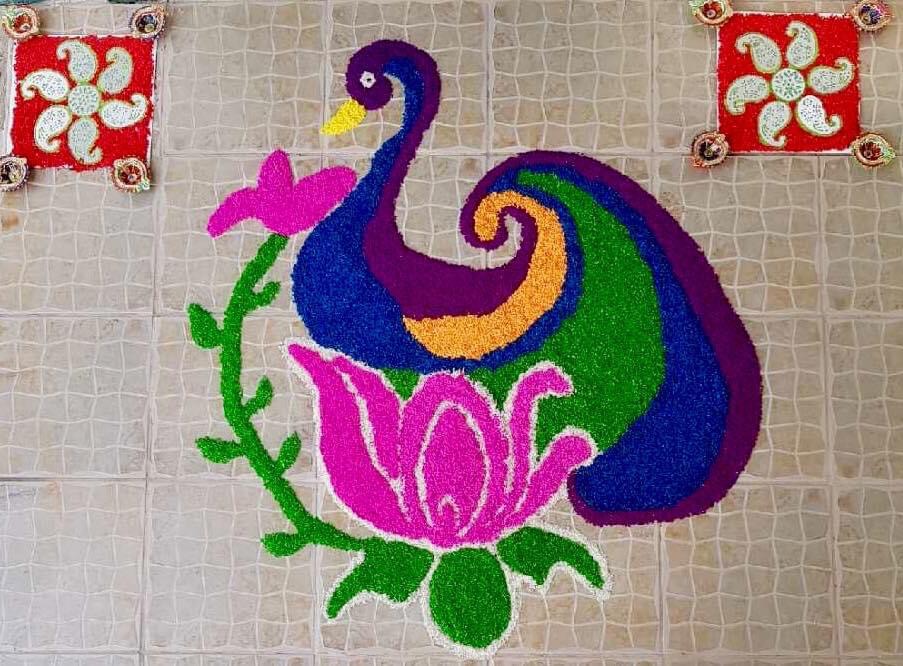
Rangoli – Indian art common during Diwali: Credit – Sweetika Kumar
I look back over the years with nostalgia. Even though my husband and I do not celebrate Diwali as a religious festival, I miss celebrating it with our Hindu friends this year. In Auckland, we are still in lockdown, so the usual getting together at friends’ homes for a Diwali celebration is not an option.
But I doubt even Covid and lockdowns can overshadow the brightness this day brings.
What I love about Diwali
Diwali is, for me, like Christmas but without the booze and meat, full of fireworks, joy and laughter. And a time for family and friends. A time also for reflection over the year gone by. And as is usual with Christmas, it is a time for over-eating. And eating more, even when you are full. I love Diwali. It is one of my favourite festive seasons.
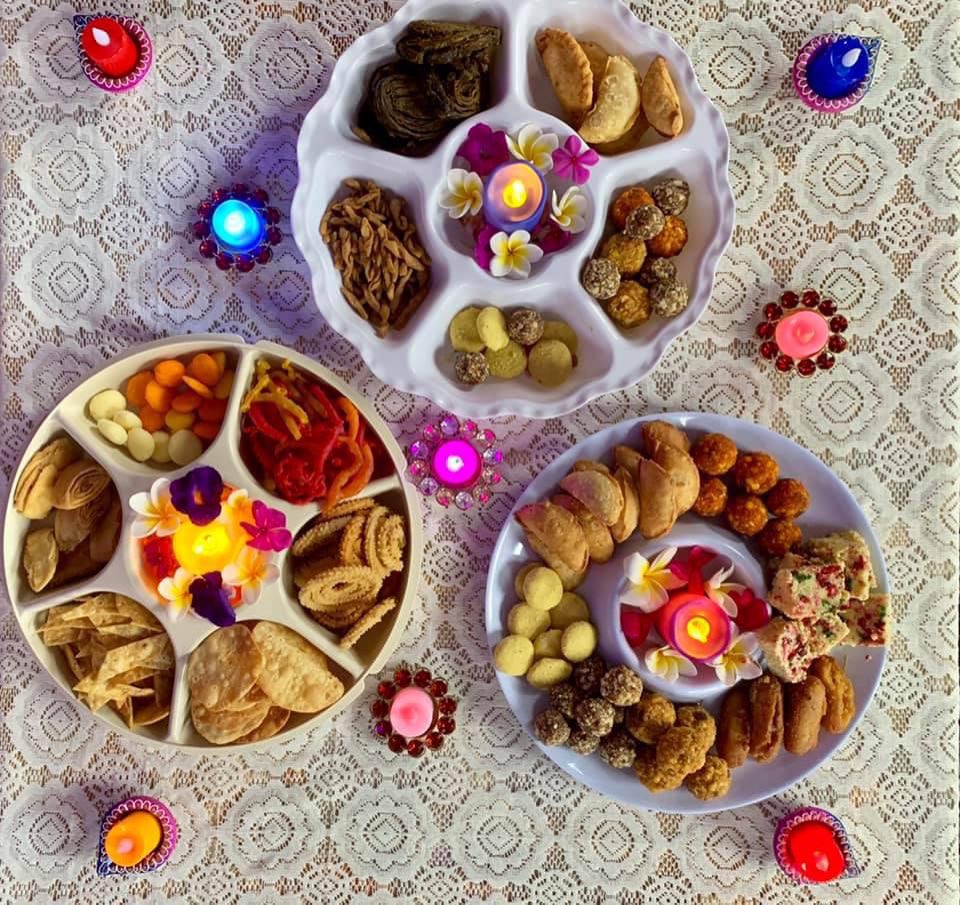
What is there not to love? The sweets, oh how I love them. And the food. The sitting down with hosts and their family and friends and sharing stories, while stuffing my face. Children and adults alike playing with firecrackers. Me, who once got burnt by a firecracker, sticking with the safety of sparklers.
I love dressing up in traditional Indian attire. This is the one day in the year I get to wear the sari unless there’s a wedding of course!
The lighting of diyas and candles is an amazing experience, especially when you get to do it with the kids. I love watching fairy lights as they flicker on the houses and compounds of those who celebrate the festival. The smell of firecracker smoke, combined with the beautiful scents from the diyas.
And a dark night lit up not just by lights but also by the glowing hearts of the hosts.
Diwali sweets: Credit – Sweetika Kumar
Triumph of good over evil
It is a day that I look forward to each year. Maybe this is so because, in Fiji, this is one of the biggest festivals. Diwali and its festivities are ingrained in me.
I remember our Hindu neighbours bringing us plates of sweets to share their joy. And despite firecrackers going off, me sleeping undisturbed.
Diwali is a day symbolic of the fight between good and evil, where good triumphs. I am not so well versed in the religious aspects to say much more. I am sure my Hindu friends will fill in the gaps with their comments.
But I must say, especially during these times, that I hope this day brings light to whatever darkness we may find ourselves in. I hope the good in our hearts, minds, homes, and communities triumphs over all the evils out there.
A very happy and wonderful Diwali to all my friends. And to Aucklanders celebrating Diwali – lockdown is only a temporary hurdle. The good always comes out winning.
I had a hysterectomy 4 months ago. My post-op experiences were quite interesting. I had some expectations of recovery which were unreal. But I made it through and thought to share how I feel now, 4 months on.
First, I must remind you, my dear reader, of why I had a hysterectomy. It was due to stage 4 endometriosis – read my story here. Not a life-threatening illness, but one that caused considerable pain and consequent low quality of life. Today, as I write this post, I reflect on what my life was like, living with endo. And how life has changed since the hysterectomy.
Period anticipation
The period pads and tampons are gone for good. With endo, I was using constantly using these products. I could never work out when the next bleeding episode would begin. Apart from periods, there was off-period bleeding. And after enough embarrassing episodes, a stash was always in my handbag.
However, the issue runs deeper than the issue of period protection. Psychologically, I am different. I still ovulate and go through pre-period symptoms of hot flashes, water retention, etc. These remind me that a period is near, but now the period does not come. And with each passing month, I feel relief.
Because along with the other symptoms of an oncoming period, I would experience pain. Three weeks out of four per month I would be in pain. I would bleed for three weeks. Liberation and relief have replaced feelings of anxiety and dread. I know now that a period is near not by the pain I feel but by my weight on the scales and tossing and turning at night due to the hot flashes.
Being around children
That said, I am now struggling with being around children. My surgeon had warned me about some hormonal and emotional changes. With the caveat that it is different for every woman. In my life, I have at least eight youngsters who are still close to my heart. I have found that whenever I am with them, whether physically or communicating on the phone, I feel detached.
Before the hysterectomy, I could not wait to spend time with these little ones (and I mean children below the age of 12). Frankly, now, they irritate me. A friend of mine suggested that I may be experiencing the reverse of post-natal depression. Perhaps…
The guilt about the way I feel about these little ones is worse. Rationalising my emotions is an exercise in futility. And it is hard to tell people, especially the doting parents that “Hey, can you please keep your kid out of my face?”. I should not be feeling this way, but I do. Will these emotions go away? I don’t know but I am willing to ride out this wave.
Pills
Pre-hysterectomy, I was on high dose pain killers. Every day. Without the painkillers, I could not function. And there were many days when I left the house in a rush, only to get to work and be in extreme pain. And then make my way home again, or put up with the pain and be uncomfortable and unproductive all day.
Generally, I do not like taking pills. Even for times of depression and anxiety, which have been many, I have preferred to be pill-free. Having the surgery has enabled me to live without pills.
Body image
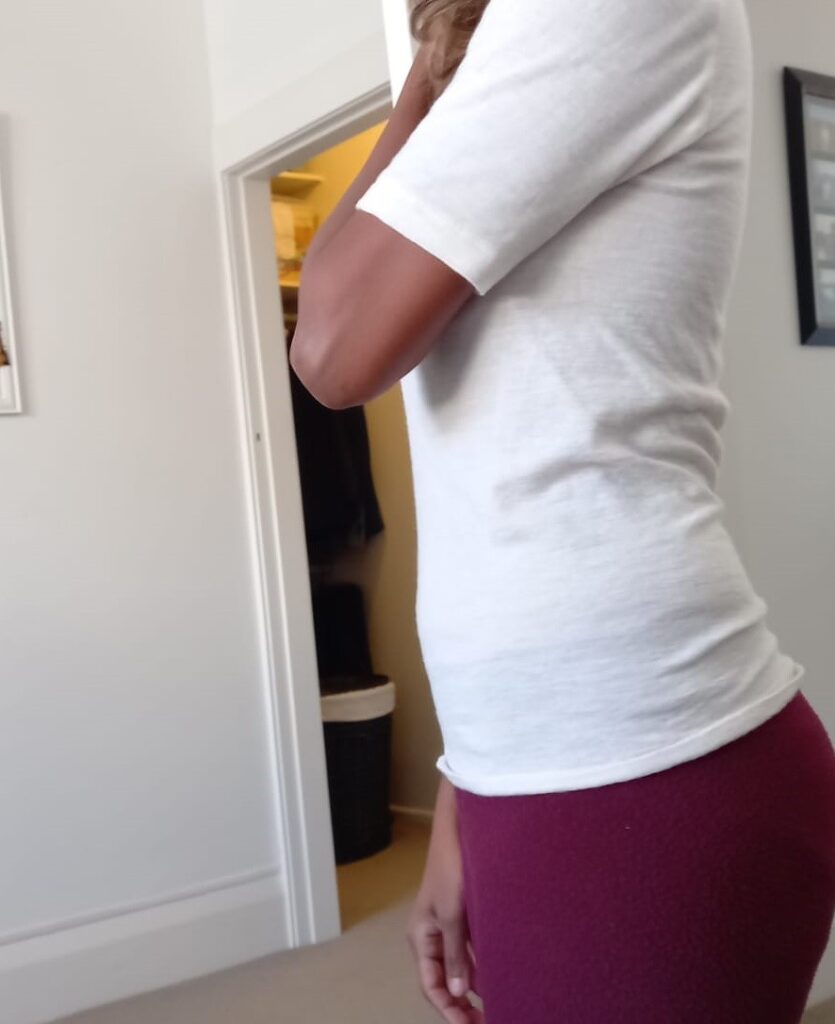
With the constant bloating and never-ending bleeding that came with endo, I became more and more conscious about how I looked. Those who know me will laugh when I say that I was so afraid of looking obese. To have a belly that looks like I’m pregnant, every day, for over two years really took its toll on me. Sure, there would be days when I had my flat stomach and I felt confident. But most days, I would hide behind baggy clothes.
It was not weight gain or obesity. It was plain and simple bloating. Consequently, I would spend a lot of time exercising, which is not a bad thing in any sense. But I became obsessed. If I went without a day of HIIT workouts, I would feel guilty and ashamed. Workouts kept the bloating at bay, most of the time. And sometimes, working out helped ease the pain a little.
In addition to working out like mad, I used to manage my diet. After a year of not knowing what was wrong with me (before getting diagnosed), I had found a natural way to reduce the bloating.
I started a food diary and noted down everything I ate, and watched how my body reacted to what I ate. Within months I concluded that my body was reacting badly to high carb meals, particularly sugar, flour, rice, potatoes. At the same time, my hubby was trying to lose weight and he was experimenting with the keto diet. Because there is just the two of us at home and I was supportive of his diet, I started cooking keto meals and I found that my body was reacting well to the diet.
And so began a year-long affair with low carb meals. It was hard to explain to friends at first, especially when I had no clue what my ailment was. But later on, after the endo diagnosis, it all made sense. Endo feeds off estrogen, and estrogen and insulin levels have a complicated relationship. I tend to listen to my body, and I felt that my body was telling me to stay off the carbs.
Keto meals became the norm, low carb cereals, breads, cakes were homemade. Dining at friends’ homes was uncomfortable. Functions at work always left me hungry. Dining out was something to be prepared for through excessive amounts of painkillers beforehand.
Post hysterectomy, I must say, some of the dietary changes have stuck with me. But I LOVE the fact that I can eat chips, a piece of cake, paella, without feeling sick with worry and anxiety about how my body will react, and the pain I knew I had to endure for ‘guilty’ food pleasure.
Struggle with body weight
If you read my story on endo diagnosis, you would know that losing weight a decade ago was a big deal for me. In hindsight, I think this was down to the onset of endo at the time.
Over the last two years, the keto diet combined with pretty hectic workouts very reluctantly shifted my body weight. I am not obese, with a weight of 49kg for a relatively skinny frame. Endo made it harder to lose weight, and there were times when I felt very uncomfortable in my own skin. The bloating did not help by the way. Now I know that the hormone imbalances associated with endo made it harder for me to lose any weight.
Four months on, I am at my ideal weight of 49kg, and I am on weight maintenance plans. That said, I noticed that it is easier to lose weight now. My weight shifted down two kilos during an emotionally draining episode recently. With no extra workouts or diets.
Was a hysterectomy worth it?
The benefits of having a hysterectomy to deal with endo are truly massive. Hysterectomy does not cure endo by the way. There are chances, albeit slim with the type of hysterectomy I had, for endo to re-surface.
I believe I will get over the children-phobia in time. And if I don’t, well, it is a small price to pay. The children will keep getting older and I am not averse to teenagers. The emotional, psychological and physiological me is better than who I was two years ago. This is said bearing in mind that I experienced very few symptoms of endo until it was too late, i.e., it had got to stage 4. Others may experience longer periods of what I went through. Consequently, their relief and feelings of liberation would be greater.
Would I not have the hysterectomy in hindsight? No. I would have it again and again.
My quality of life is far better now. The feeling of liberation and anxiety-free days, not worrying about period leaks or periods, not worrying about dressing to hide bloating and period leaks, the fear before periods, a life of chronic pain.
The ability to eat things and not worry about the side effects. My bodyweight not stuck with hormone imbalances. Being free from pain and bleeding.
These changes in my life have been for the better.
Last year October (2020) I remember having a discussion with work colleagues about how surreal it was that the rest of the world was battling Covid and here in NZ we were living in freedom. It seemed like we were on a different planet. And I think we were.
Credit does deserve to be given to the government of the day for managing Covid in early 2020 and achieving elimination. Everyone will agree that elimination was necessary so that as a country we could prepare ourselves for the pandemic.
But that’s where elimination should have ended.
It was a strategy that gave us time and space to think long-term and be prepared for the inevitable – that Covid was here to stay. It gave us time to have a proper roadmap. To look at what was happening in other countries and learn from their mistakes. Use these learnings and prepare the whole nation for vaccinations and learning to live with Covid.
Pull resources together and prepare for more ICU beds and specially trained medical personnel. Take Covid plus variants head-on. Something the rest of the world was not able to do. And achieve gold standard this way.
Personally, after the second lockdown in 2020, my view quickly turned to that – Covid was not going to get eliminated in the world, let alone in NZ. And to continue burying our heads in the sand and living in our freedoms were, while enjoyable, very short-term outlooks.
Covid was always lurking around the corner.
What was required back in October 2020 was not a focus on how well we have done with managing Covid but a focus on how well we can do with Covid in the future. We all however tend to live in the present.
While we were busy with ourselves, the rest of the world was getting on with Covid. They dealt with deaths, they dealt with overwhelmed hospital systems. Even dealt with being called morons by us. But, well, here we are. We wasted away precious time.
Some will say that we were ready for long-term Covid. I argue not. Elimination created a false sense of security, for which we are now paying the price. Here’s why.
Delta was creating chaos around the world, and so close to home – Fiji, April 2020. This was when we had also bubbled with Australia, where Delta had already arrived. Elimination taught us all – leaders and followers- to become complacent.
On one busy Saturday afternoon, the ferry captain announced that masks were mandatory for all passengers, but over 50% were onboard without a mask. When my husband kicked up a fuss with the ferry staff, he was told that the transport operators were not allowed to refuse mask-less passengers onboard. And it seemed like very little people cared that they had no masks on. Complacent? Or simply did not care.
This was the reality for most Kiwis. Why contact trace, why wear masks, when we have no Covid to deal with?
“The reactive space in which the response has so far existed has meant that these governance structures have remained at the “tactical” or “issues-management” level, rather than being able to set strategic or future-focussed agendas for the response.” Page 12
“Interviewees acknowledged, however, that the system has been largely in reactive mode. We heard there is a real desire to shift to a more strategic and longer-term way of thinking and operating; to get ahead of issues rather than constantly reacting to events as they emerge…Across our interviews, there was an emerging consensus that COVID-19 will be the dominant challenge facing New Zealand (and the world) for at least the next 18-24 months.” Page 11
This report is dated October 2020. A year ago. The reviewers clearly stated that Covid was a challenge for the next two years. Yet sadly, we are making up things as we go in this outbreak. Why think of a future with Covid in it, when it has been eliminated?
Vaccination
Some blame Pfizer for delaying the vaccine delivery. I have no facts here. To date, the vaccine procurement process and contract details have not been made public. We have no factual data, either way, to substantiate any claims because sadly, there is no transparency on this issue.
However, a government media release in January 2021 claimed that our vaccination programme will be the “biggest ever” – https://covid19.govt.nz/alert-levels-and-updates/latest-updates/covid-19-vaccine-slated-for-possible-approval-next-week/ It also stated that “We hope [emphasis added – they did not say plan] to start vaccinating the wider population mid-year.” Delta arrived in August 2021. At that point, or even before that point, there was no “Super Saturday”, no free sausage sizzles, no seats in business class, etc. to get people vaxxed.
We did well with Super Saturday. It was a great idea. But this type of hype to get vaccinated, when we had time on our side, could have started from January 2021? By now, 10 months in the making, we would be at the desired goal of 90% vaxxed. And our much-coveted gold standard.
But, we are again chasing our tails. With Aucklanders paying the brutal price of a complacent, reactive, irresponsible government. The hype started only when Delta arrived. Why? Elimination. Because we had no Covid. There was no rush to vaccinate the masses.
At a time when the government had a real leadership role to play, it chose the path of self-adulation. It wanted to prove to the rest of the world that they were better than the rest. Elimination and a Covid free NZ were messages the government held on to for 18 months. While other governments were working hard to promote vaccination.
It is irresponsible to expect the nation to change its mind as quickly as the government has (abandoned elimination in a day)? Change does not happen overnight.
I have heard about people in the country who still think they can remain unvaccinated because they have lived without Covid since May 2020. Elimination created this false sense of security.
To date, not one government personnel has admitted that they were lax in preparing for Delta. Not one person has said sorry to Aucklanders, for not moving MIQ facilities out of this city.
Rather, the arrogance carries on. Another milestone for NZ to achieve – be the world leader by being the most vaxxed. What does being a world leader mean to an Aucklander who gets out of level 2.75 into a vague traffic light system?
We are now paying the heavy price for putting all our eggs in the Elimination basket. It worked well, yes, but only for the short term. Even in the face of Delta in August 2021, we brought out our Elimination basket. While the rest of the world was and is looking ahead, to endemicity.
Now would be a good time to prepare the nation for what lies ahead, in the longer term. But, we are messing around with alert levels and traffic light systems. Again, very short-sighted. How very responsible!
PS: One may say that this virus caught the world by surprise, and our government was dealing with it in a reactionary manner, like the rest of the world. I beg to differ on the simple point that, yes, we had no blueprint, but we had the benefit of time, and our geographic isolation.
We were living in freedoms that were not available for the rest of the world for most of last year and early 2021. During this time, we could have used the available science, data from the rest of the world, their experiences, etc. to prepare for the inevitable. I do agree that last year we did well. But we lost focus. And sadly, we are none the wiser still.
One might also argue that all this commentary is beneficial in hindsight. I argue that last year, in August 2020, I was one of the few people who was calling Elimination out, who was calling out the lack of long-term thinking. And I am an ordinary individual. I am not a civil servant. If I have the capability to think ahead, why are our government ministers exempt from this ability? Do we not vote them into power to do such thinking for us?
They have the resources to do long-term forecasts, to get the best in the country to do this type of work for them, they have the resources to tap into WHO and other scientific data, to talk to other world leaders and analyse what has worked and what has not over the last 18 months. The fact that they did not make use of these resources does not make me a bad person for calling it out.
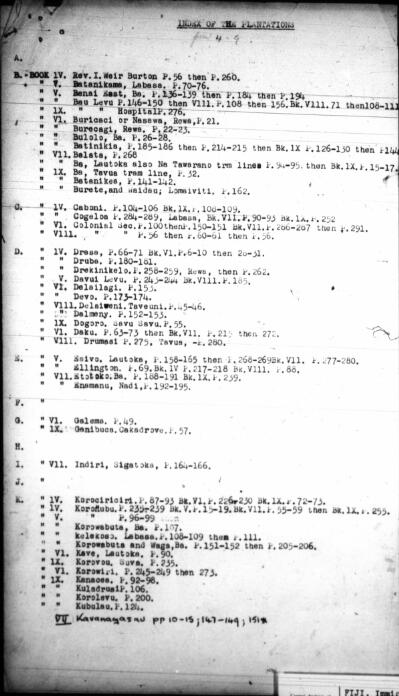
This database is a compilation of records of Indian immigrants on the plantations in Fiji at the time. Within the plantation database, there are 9 books or volumes of records. The books are organised chronologically. In book/volume 1, there is an index of the plantations, which will guide you to the books/volumes and page numbers you wish to investigate – see image below.
Excerpt from Book 1, Plantation records
Once you have the right plantation record and year, search using the ancestor’s pass number. Alternatively, if you are like me and have no pass number, read through all the names.
Next, to ensure you have the right ancestor, repeat the process of looking them up in the General Register to find out who they married, which children accompanied them, etc. When you know you have the right person, look up that person on the Girmit database by name and pass number to access their emigration pass.
Sometimes, the Plantation records are the only links to the missing pieces. If one knows which plantation their ancestors worked in, this is a great resource to use.
Hints
The hardest part of my research was not knowing the pass numbers for one set of great grandparents. This was so because they were born in Fiji to Girmitya parents. The Plantation records were helpful in this circumstance. Without a pass number, the Girmit and General Register databases are of no help.
To resolve this issue, I decided to search for the parents to whom my great-grandparents were born. Unfortunately, I did not know the names of one set of great-great-grandparents. My strategy was to look in the Plantation records for my great grandmother’s name.
How did I know which plantation records to search? Good question.
I knew who that this great-grandmother had married – GGF#4. From my research, I found that most people married within the plantation. For example, on mum’s side, her maternal grandparents arrived separately at a plantation in the Central Division but later got married while at this plantation.
Consequently, I looked within the plantation records within which I knew GGF#4’s parents were working.
Finally, having done the hard yards here’s some information that you will find useful:
Book 3 is a replica of book 2 after the first two pages. This book continues in Book 4 after image number 418 in Book 4.
Book 6 is incomplete. I was looking for pp. 197-206 but these are not there. The book stops at image 131, page 65.
In Book 8, image 442, there’s a note saying, “Continued from Book VI, page 206”. But as noted above, there is no page 206 in Book 6. Book 6 ends on page 65.
Origins in India
To locate which places in India ancestors came from, Google Maps is helpful when used in comparison to the map of India at the time of indenture. I found that the information on the passes was accurate to the extent that they pointed me to the villages, thanas and districts that existed at the time of indenture. Since then, the provinces have changed in India and as a result, so have some district names and borderlines.
To keep things consistent, I relied less on Google maps and used old maps of India first and foremost to locate the district as noted on the emigration pass. For the bigger districts, the names of some of the thanas appeared on the old maps. Looking at the locations gave me an idea of where to look in modern maps, like Google maps.
Generally, the information on the emigration passes resembled what was the map of India at the time of indenture, and current India. Faizabad, for example, was a district back then, it is now a division, and currently, Faizabad is a development block (previously a district) within the district of Ayodhya. So, you will have to do some research on the districts and their histories.
The old maps are a good guide, and I found the David Rumsey Collection very helpful. You can download them for free. Find these maps on old maps online.
Final words
In summary, the plantation register is somewhat incomplete. As a result, the search for my sixth ancestor remains incomplete. I could not find her parents names on any of the plantation records. It is my view that the missing books and pages may have held the key. However, there is no way of retrieving this information.
In the next post, I address other ways of finding out information when such a predicament arises. I am yet hopeful that at some point in time, the search for my sixth ancestor will bear results.
Wow…you have come this far! I hope you have had success using the last two databases – Part 1 and Part 2 – and cannot wait to learn how to progress further!
Please read on…
General Register database
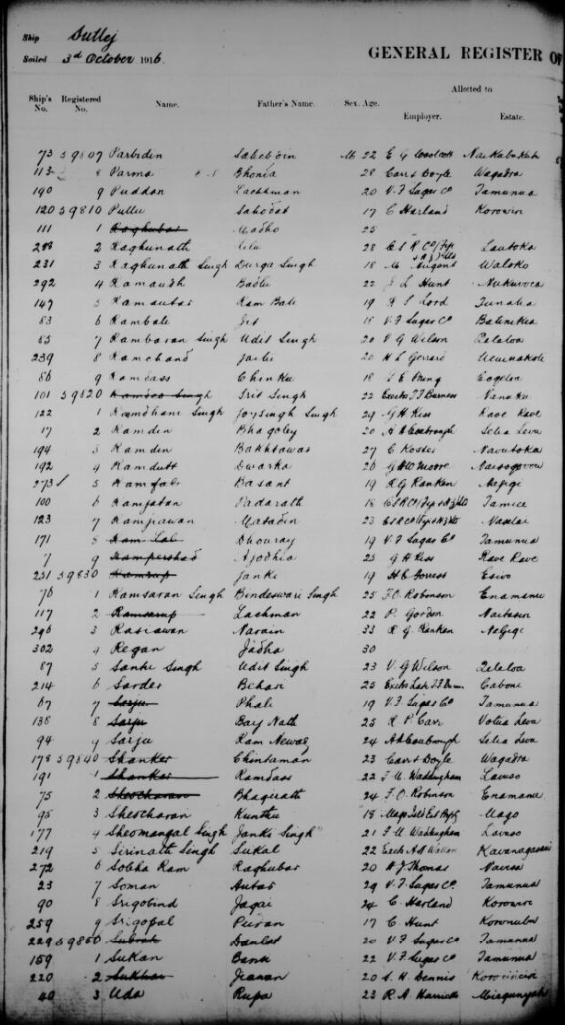
The General Register of Indians in Fiji is another useful resource. Within the register, you will find details such as where in Fiji they went, who they married, whether and when they returned to India, death date, etc.
Within the register are 9 books, organised according to ship arrivals and emigration pass numbers. Each book title lists the passes contained within that book. For example, to search for pass number 1712, search within Book 1, which contains information about pass numbers 1 to 12281.
Each person or pass number has two pages of information – see images below.
Example of General register – page 1 of 2Example of General register – page 2 of 2
Migrants’ pass number, father’s name, age, sex (from their emigration passes), and location in Fiji are on the first page. On the second page, there’s information pertaining to their marriage records, death, etc. The red circles on the above image show the marriage records. There are no names, just pass numbers of spouses.
The second page was very useful in all my ancestry searches. For example, I knew the names of both great grandparents from my maternal grandmother’s side. The General Register records validated that they married each other.
Hints
If you know the name of one ancestor, this register can help you find the other. For example, to find GGF#2, looking up the records of GGM#2 in the General register revealed which pass number she got married to. I found GGF#2’s emigration pass number in this register.
The only drawback of this database is that all records are on Microfilm, and people’s details are handwritten. Therefore, there are obvious challenges with deciphering the handwriting. Additionally, if the microfilm is of poor quality, you cannot get much information.
At the end of each search, my eyes and head hurt. It is hard work…reading pages and pages of information. Take lots of breaks, but do not give up. The pain is worth it.
Moreover, if you do not know where to look, going through this database may feel like trying to find a needle in a haystack. But the results are always worth it! I have felt joyful each time two and two came together as four as a result of this database.
Finally, to know which plantation ancestors worked in, which is our next database, the records on the General register are very useful. The next post is the last in this ancestry research.
In the last post, we went through the Girmit database and how to search for ancestors using their names, arrival date, or ship name – Part 1. In this post, we review the Family Search database.
Family Search database
Family Search is a worldwide database to help locate ancestors. Signing up is free and this database links to other genealogy/ancestry sites such as the New Zealand Genealogy Society (NZGS).
The records are pulled from primary databases in source countries, including Fiji. This database helped me link my ancestors with the rest of the known family, or to find the missing link. For example, I found GGM#1, a missing link, through her children’s records on this database. Finding her led me to the right GGF#1.
Through the Family Search database, you can find records of marriages, deaths, and passport applications in Fiji from 1900 to 1989. That is IF these events got registered.
To access the records, create a free account. Every time you do a search, always remember to put ‘place’ as Fiji at the bottom. You can amend the search using other filters. Some filters are alternate names, a life event, the year range of the life event, etc. Please see the image below.
Excerpt from a search on Family Search
Hints
This database helped tie some loose ends in my research. For example, I knew the name of GGF#1 but I did not know the name of his wife, GGM#1. To verify this information, I searched within this database for evidence of the marriage/union. Evidence can include the names of any children that came from the marriage/union. Thus, I searched using the known names of my uncles and aunts, including my parents.
I found GGM#1, through the names of her children (my uncles and aunts). These findings were instrumental in linking GGF#1 to GGM#1. I could not find their marriage record, however.
Also, I could not link GGF#1 to my aunties and uncles. Some names are misspelt on some of the records. It was a blessing that GGM#1’s name was spelt consistently right for all her children’s records. Therefore, be prepared to search for names using various spellings. Ram Swarup, for example, can be spelt Ramsarup, or Vikashni can be Vikeshna or Bikasna.
In this respect, this database can be a bit limited, so if you have an opportunity to get connected to an affiliate library, do so. Such an affiliation will help you access proper microfilm records. I signed up to the New Zealand Genealogy Society (NZGS) to access the marriage and birth records of my great grandparents. It is a worthy investment because these microfilm records are not available freely on Fiji Archives, the National Library of Australia, or the Girmit database.
Note that the records on Family Search are up to 1989 only. Sometimes if life events were not officially recorded, those details will not show up here.
The late Mahatma was the inspiration for my ancestry research. This post is part 1 of a 4-part series, which I described in my introductory note to the search for ancestors. We start the research process with the Girmit database. In all 4 parts of this series, I have used a numerical system to identify my ancestors as I wish to keep their details private.
Girmit database
The Girmit database was the starting point in the search for my GGF#1. It is a great resource to search for names, look up emigration passes, ship name, date of arrival, etc. For GGF#1, I found him by typing his name into the search box when I opened the List within which his name was to be found, i.e., his name started with G, so I looked in List G – refer to Step 1.
Note that currently (as of October 2021) they have names that start with initial M and subsequent letter of ‘a’ only. For example, Manoj can be found but not Meghna or Munna. You could alternatively skip to Step 2 if you know for sure which ship they came on. The ship names records will have the remaining names i.e., from initials M+e and onwards.
Also, please be aware that there are many Ganges or Sutlejs, i.e., Ganges I, Ganges IV, etc. So, you know need to know the exact (Ganges) ship. I did not know any of this information, so for me, the list of ships came in handy when I was working backwards from the General register or the Plantation records.
If you know the name of the ancestor and what date/year they arrived in Fiji, find their emigration pass by searching the ship name and the pass number.
Step 4: Emigration pass number – the key to other searches
Once you get to the right record, you can save the image. And if there is an accompanying wife or children, their names are usually stated within the husband’s/father’s emigration pass, along with the wife’s number. Then use any of the steps from 1 to 3 to find the others.
Whichever method you use, the idea is to get to the emigration pass which will list ancestors’ names, fathers’ names, villages, and districts, etc. Each of the above search methods will lead you to a Trove site that stores all the microform records, in their original state, as you may find in Fiji Archives.
The Trove site allows you to move through records. I just take an estimate. For example, if the first pass number starts at 1 and I am looking for 101, I skip through the first 100 records using the navigator. There is a movable cursor at the top of the Trove site. You can move through records using this navigator.
Hints
The emigration passes may state additional information, such as accompanying wife or children, but this was inconsistent in my experience. On some passes, the wife and children are mentioned, but on some, you must pay close attention.
For example, I found GGF#2 by looking up the pass number GGM#2 married on her General Register record. Next, I looked at the list of ships to see which ship his pass number belonged to, as I had no idea what the arrival date was. On the ship records, I arrived at GGF#2’s records. To my surprise, the Next of Kin line read as “son of #111”. Trawling through the entire ship’s records to find #111, I discovered that GGF#2 also travelled with an elder sibling.
The sibling’s record was found because I noticed a similar father’s name. The district, thana and village information were the same as GGF#2’s. The next of kin was also stated as “son of #111”. In the end, I found #111. However, in the case of GGF#4, on his parents’ records, there was no mention of him accompanying them. It was only when I found GGF#4’s pass did I discover that he travelled with his parents.
A note here about the numbers listed on the passes themselves – e.g., #111 used in the above example. This number does not refer to the pass number. It refers to the depot number. Please see the image below.
Excerpt from an emigration pass
The ship’s records are different from the emigration records. All passengers on the ship had a depot number, which is marked with the green circle above. When looking for the next of kin within the ship’s records, it is the depot number to look for.
This database also comes in handy when you are working backwards – from Plantation records or General registers, to ship name, date of arrival, and pass number. For example, GGM#3’s emigration pass number, as well as her parents’ names and pass numbers were unknown to me. No one in our family knows anything apart from her first name. I found her parents’ names using the Plantation records database, which we will cover in Part 4.
In summary, the idea is to find ancestors’ pass numbers, then double-check on the General register (covered in Part 3) for links to others, such as parents or spouses. Upon verification, look for the pass numbers on the Girmit database.
Finally, as much as I recommend the Girmit database for ancestry research, I do so with a word of caution. In my experience, I noticed that the records of GGM#2’s parents do not appear on the Girmit database. Only GGM#2’s records are on the database even though she travelled as a child with her parents. Her emigration pass states her parents’ names, they all came on the same ship. Yet, her parents’ names are not on this database.
Additionally, when I found out the pass number of GGF#2 from GGM#2’s General register records, I found his emigration pass from the Ship’s records. BUT searches for his name on the alphabetical list produced no results. So, if you don’t find names on the alphabetical list, do not give up. It just means that the database is still not as complete as it could be.
A few weeks ago, one of my best friends celebrated a milestone birthday. She is in another country, also in lockdown so the best we could do was to have a video call. During the conversation, I mentioned my ancestry project and she asked me how I found out everything. Up till that point, I had not thought about how my research and experiences may be useful to others. My entire goal had been to reach conclusions about my own ancestry. I had not considered what to do with my experiences after that. She inspired this post.
My journey began with no knowledge about my ancestors. I did not even know their names, nor when they came to Fiji. I asked an aunt and uncle about the name of their grandfather, i.e., my great grandfather. The search started with this one ancestor and quickly blossomed into six ancestors.
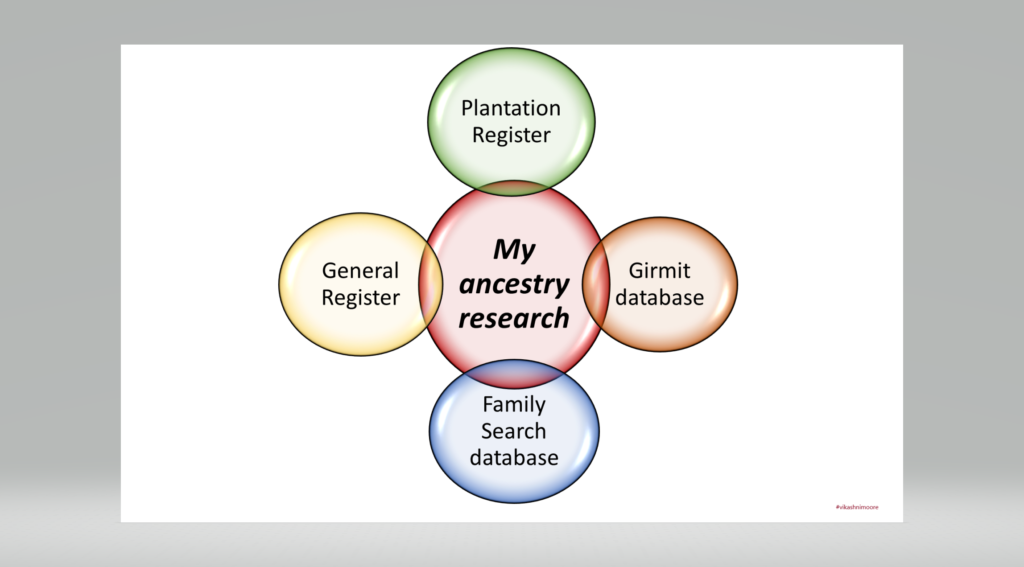
The entire research process is an extensive read. I used four databases in my research. There are four posts, for each database. In each post, I provide notes on how to use the database and some reflections on lessons learnt.
The databases I used
In Part 1 I describe the Girmit database and how to search within this. Part 2 is about the Family Search database, while Part 3 has notes on the General Register of Indian immigrants in Fiji. The search process concludes with Part 4, with notes about the Plantation Register of Indian immigrants in Fiji, and some insights on how to search for places in India at the time of indenture.
I refer to my ancestors with a numbering system, such as great grandfather 1 = GGF#1, or great grandmother 1 = GGM#1, as I would like to keep their information and their details private.
It is my hope that the notes and experiences I shared with you in the next four posts will assist you, my dear reader, in your Girmit ancestry journey. And to my beloved friend – this is for you.
One night towards the end of July 2021, while I was recovering from a hysterectomy and was off work for three months, my husband and I watched the movie titled ‘Gandhi’.
The movie moved me more in my forties than the story as I recall it being told when I attended primary and secondary school in Fiji. The schools were called Mahatma Gandhi Memorial schools, dedicated to the man born as Mohandas Karamchand Gandhi.
Back then, I considered him a patron of our school and a liberator of the people in India, from issues such as the caste system and the British rule. At that time, I had little appreciation for India and her struggles for independence and all the issues fought by Gandhi. All I cared about was Gandhi Jayanti.
In school, every year, on October 02, we would remember the Mahatma, for October 02 is Gandhi Jayanthi – the day he was born. There would be, of course, speeches from the school Principal, and one or two students, as they reflected on the life of Gandhi. There would be some traditional Indian dances and some songs that we all sang. ‘Jay Jawaan, Jay Kisaan’ was one. I still remember some of the words of this song quite well. We would then be given packets of Indian sweets provided by the school, and for the rest of the day, there would be various activities such as debates, quizzes, and sports. We didn’t study at all. The whole day was dedicated to the Mahatma. For me, Gandhi Jayanti was more about these activities rather than the man himself.
And then the movie night happened. His work, his life, his dreams sank deep into my soul. A liberator of his people, in his time, in his own special way. Which made me think of my ancestry.
Now, in all honesty, I have thought about my ancestry many times, often as a passing thought, over many years. I had gone beyond just thinking about it when hubby and I visited Trinidad and Tobago in 2015. Pre-Covid of course! One in two Trinis were Indians, which I had not anticipated…shows my ignorance back then. What had fascinated me about the Indian heritage there was that the local cuisine featured by our hotel resembled some of the dishes that are also are a part of the local Fijian cuisine. I was intrigued.
I then read about the history of Trinidad and found that the Indians there had been brought in by the British in a similar way as the Indians to Fiji – through the “indenture” system. I also learnt that most of the Indians in Trini and Fiji had come from the Indian states of Bihar and Uttar Pradesh. The Trini Indians spoke a language I could not understand, and I surmised that their language had gone through a similar transition process as the Hindi version in Fiji, borrowing many words from both English and indigenous languages.
Anyway, I digress.
After much research, to compensate for, or overcome, my ignorance about the plight of Indians and the other issues that Gandhi fought for, I have come to realise that Indians were not only sent to Fiji and Trinidad and Tobago. They were also sent to other British colonies back then, such as Mauritius, Natal, Guyana, and Jamaica. According to scholars (e.g., Allen, 2008; Mahase, 2008) on the topic of the indenture system, the reason for Britain looking to India to provide labour in the colonies was because the African slavery system had come to an end in 1834. However, work in the colonies, particularly on plantations such as sugar, coffee, tea, rubber, cocoa, and rice, needed to be carried on and cheap labour was essential.
I will not re-write history here on how Indians were misled by local recruiters about the new life that awaited them in the colonies, nor the harsh realities they faced upon arrival in the plantations, nor the hardships of the life left behind in India being equal to the hardships endured in these colonies. Rather, those stories have been told and re-told over the course of history, and my quest here was to find my own history.
Back to the Gandhi movie and the day after…
I spent the entire day lost on the internet…looking at articles and websites that fed my mind with stories of the life of Indians in Uttar Pradesh and Bihar. The languages spoken, the types of food that were prominent, the customs and etiquette, consumed me. It was news to me that these states were located on the plains around the river Ganges, very close to Punjab, West Bengal, and Dehli.
Then I got bored, towards the end of the day, when I had not found much except that some of the staple foods eaten in these states were similar to the food we ate in Fiji, like the chokha, dhal, saijan, and jackfruit. I did not think more about this as I was recovering from my hysterectomy.
But fate had other plans. Ten days later, I dreamt about me being in India, in a village that was situated alongside a river which I referred to as the Ganges in my dream. Have never seen the Ganges in real life! I believe this dream was a result of my mind still processing what I saw in the Gandhi movie and the questions within myself that followed days after. I had started to wonder where my ancestors came from.
Which prompted me to get serious, like super serious, and do some proper research. And thus began a wonderful and fulfilling journey for me. A quest for my identity. I have long held the view that I am Fijian, and that view has not changed after the search for my ancestry.
What has changed is the level of appreciation I now have for the difficulties my ancestors encountered, the decisions they made, the lives they lived…all so I could have my life lived so differently from theirs. Until quite recently, I had never given their plight more than a passing thought, even when I read a few stories of Girmityas in Fiji as part of the required literature for a vernacular class at school.
The word Girmit is another example of a word borrowed from another language and made our own. Indians back then signed an agreement, the indenture contract, for their terms and conditions of work in Fiji. Girmit is derived from the word ‘agreement’. Girmityas are the people who served the Girmit, the set of people which includes my ancestors.
Throughout the two-month journey of researching and putting pieces of the family jigsaw together, I have gone through a roller coaster of emotions. I have sunk to the depths of despair when I encountered dead end after dead end. I have cried for hours on end when I triumphed and got past the dead ends. I have felt gratitude towards the record keepers of the emigration passes, and the registers in Fiji which held details of the Girmityas. I have reflected on the fact that these people meticulously filling out forms probably had no idea at the time that they were indeed writing history when they were penning these records. But above all, I have felt overwhelming joy, pride, and sadness as I found my ancestors and reflected on their journeys.
Without them, there would never have been me. And without Gandhi, the indenture system, which was more like a slavery system in disguise, would not have ended. It is a bittersweet event in history, nonetheless. For while they came as slaves and experienced hardships that I could never possibly fathom, in doing so, they paved the way for future generations to live lives that they never got to live themselves. They left a legacy, for which I am truly grateful.
And the Mahatma – well, he spoke to me from beyond his grave. After all these years, so many years since I attended schools named after him, he inspired me to find my roots. And even though I did not plan any of this, it is quite timely that today, on Gandhi Jayanti, I write this to pay tribute to this great man. Today, I reflect on how the past always has a way of paving one’s future.
In the next post, I will describe how to conduct the search for ancestors. For me, it was all a matter of finding out for the first time how to do such a search. I hope my experiences will help others like me. In the last post in this series, I will share my reflections on the ancestry search journey.
I am a woman in my forties, have never had children, and now do have most of the reproductive organs required to produce children. Having suffered from stage 4, or deep infiltrative, endometriosis for most of my life, a hysterectomy was recommended as the only option to live a ‘normal’ life. However, despite having had the condition for a long time, I only became aware of it after a diagnostic laparoscopy in November 2020.
My history with endo is yet another story, but in summary, from the time they started, my periods were heavy. I used to be in chronic pain during periods, to the extent of being bedridden for the most part, being unable to engage in daily activities, and I was constantly worried about leaking and consequent embarrassment. All the GPs I consulted told me that these conditions were normal, until about two years ago, when a truly concerned GP decided that it was time some investigations were done. In July 2021, the end result of a lot of investigations was the hysterectomy.
Now, I am quite aware that a hysterectomy does not cure endometriosis, it just removes the painful symptoms, and am also aware that it may come back at some point. At least, then, the procedure will not be as extensive as the one I have just had.
I decided to write about my experiences following the hysterectomy for reasons explained shortly. Before I dive into those reasons, it must be said that every woman’s journey to get to the point of having a hysterectomy is different. I do not presume to know your journey, and what battles you have fought to get this far. For me, even though I had suffered every month for over 25 years, I had never imagined I would be here. Yes, there were times when I wished I did not have the uterus and was pain-free, but those were moments induced by extreme pain. Afterwards, I would forget about such thoughts and get on with life, until the next period came around.
But when I was informed by the lead surgeon last year November that a hysterectomy was the best option, it did make me feel very emotional. For me, it was more about not having children EVER, even though up to this point I had reconciled myself to the fact that children were never going to happen anyway.
Consequently, I would tell people that it was my way of saving an overpopulated world and that there were many children in the world who needed love and care, which I could provide. All these rationale arguments paled in comparison to what was staring me
in the face – a life-changing experience if I went through with the hysterectomy.
I also thought deeply about what it would mean for me as a woman. Child-bearer role aside, the reproductive organs were what made us women different from men. But as I delved deeper into these ideologies, I realised that my identity as a woman was not intertwined with organs inside my body. Being a woman meant so much more than that to me. It was in the way I thought, and felt, and expressed myself. It was in how I looked and dressed and related to others. And it was in the nurturing and caring that I could still provide, not only to children around the world, but the sick and lonely around me.
I realised that none of these things were possible if I continued to be in pain three weeks out of four (living with endo in the last two years got to this stage), and not knowing when I would be in so much pain that I would have to stay at home and let others down by not being where I had promised to be. Holding on to the uterus, and other organs infiltrated by endo, meant that I was limiting my life in so many ways. So, I decided to have it done.
The recovery at home has gone well for the most part, but it has been an exercise in patience, and why I am writing this. Prior to my operation, I had read lots about what to expect after the surgery and upon discharge. In some ways, what other women experienced have also been my experiences. In other ways, I found that no one had talked about these things – the practical things, and what the road to recovery really looks like, which motivated me to write.
From the first week post-op to week 4, for the most part, the journey felt like I was taking one step forward, then two backwards. I had not been prepared for this, and having discovered that recovery did not happen in a linear fashion, I imagined others going through similar procedures may benefit from reading about my experiences.
I have written down my experiences on a weekly basis for up to week 7 – each week has a title that best sums up that week. I have also given special attention on the first two days in hospital post-op, and added sections on the practical things, such as sleeping positions, changes in me post-op, etc. You may read the whole thing, or skip to the sections relevant to you using the contents table (revert to the contents table using the ‘Back’ arrow). I hope you find my experiences helpful in some way, even if your journey to the hysterectomy has been different from mine.
Love, Vikashni.
The surgery – a hysterectomy
Andbilateral salpingectomy (removal of both fallopian tubes) + oophorectomy (removal of one ovary) + endometriosis excision from the pelvis including bowels
Now, that’s one heading I thought I would never write, but there I go – never say never!
The hysterectomy (and other surgical procedures) happened in July 2021 and it was a major surgery, which went on for just under 5 hours. There were 4 surgeons in the room – 3 gynaecological surgeons and a colorectal surgeon.
It was a week after the operation when I was finally able to read the surgery report. They found that my uterus, which had always been retroverted, had become enlarged almost the size of my face. There was growth within the uterus – something called adenomyosis. And it had grown heavy and had attached itself to the bowel. It is no
wonder I was in so much pain all the time, especially after eating and going to the toilet. The left ovary was tucked underneath the uterus. This ovary, both fallopian tubes, the bowel area (rectum), and cervix – all these organs had endometriosis growth and consequently were also stuck to each other (adhesions).
So, the procedure was to delicately strip away, bit by bit, the uterus from the bowel first, which took the first two hours and a bit. Then they removed endometriosis from the rectum, removed adhesions from the vaginal wall and then proceeded with the hysterectomy – uterus, fallopian tubes, cervix and left ovary were taken out. A lot of work, done by a team of highly specialised surgeons.
In the hospital – right after surgery
I was in the post-operative recovery area for over 2 hours, then moved to the recovery ward. Only when I heard my husband’s voice, I forced myself to wake up so I could see him. I was in hospital for three days and two nights.
Having been out for over 2 hours, I missed the post-op briefing with my surgeons and it was no biggie because they came to see me the next day. When I came to, I felt intense pain and called out to the nurse, who came to my rescue and gave me some immediate pain relief. At some point afterwards, I was moved to the ward – I remember only bits and pieces of this: the motions of being moved and voices around me telling me where I was going, etc. I was ‘plugged to’ a number of things – 8 in total! Oxygen tubes under my nose, the IV line connected to water and another tube in the same IV line in my arm connected to the PCA machine (patient controlled pain dispenser), a drain on my left side connected to a tube that ran inside one of the incision sites on my belly, each leg in a strip that was connected to a machine which caused contractions on my calves to prevent blood clots, a catheter tube attached to a urine drain on the right side, heart rate monitor connected to the right hand pointer finger, and the blood pressure machine attached to my right arm. Of course, when I woke up in recovery, I did not realise that I was
connected to these things but became aware of these the next day. I felt wired and tied to the bed.
I happened to ask the nurse at some point during the first night if I could get up and go to the bathroom, and he asked me why. I replied that I needed to pee, and he laughed a little, and told me I had peeing since post-op and showed me the catheter. It took a while to register, and I asked him – “So, should I just go?”, which amused him further and he replied that I should, just, go! I did not wet the bed, but rather, the catheter did its job :).
I had all I needed for those first 12 to 18 hours post-op. And there was a call bell if I happened to need anything. The nurses checked on my vitals throughout the night. And the pain was managed by me, through the PCA. I slept as much as I could, despite the constant check-in by the nurses.
I had thrown up at least twice during a previous general anaesthesia induced procedure (a diagnostic laparoscopy) and did not wish the same to happen again. During pre-op consult, the nausea issue was discussed, and the anaesthetic doctor also said that the last thing they wanted after a complicated procedure like mine was for me to empty my insides and further strain the already strained organs. Thus, they gave me lots of anti-nausea post op and I was vomit-free all the way.
First day post-op
My surgery took place in the afternoon, and I was in the ward by 9pm. The next morning, I did not feel hungry and when they removed all the tubes and machines and asked me to move about, I had to summon all my strength and do so. I got off the bed, could not stand, sat down, and tried again. Prior to my surgery, a friend of mine who is a nurse and who had also had a hysterectomy had advised me to build up physical strength. I normally exercise 5 days a week, mainly HIIT, which I carried on as usual. But at least three months pre-op, I upped my strength training and started doing lots of weights. Body weights, dumbbells, lots of strength training.
I was able to lift my husband, who weighs 70kg. Initially I could lift him off the ground to my ankles, but towards the end of the three months, I could lift him up to my calves. I swear that this training helped me post-op, starting with the day after surgery. I used my leg muscles to heave myself up, just like how I used my leg muscles to squat and then lift my hubby.
It hurt to get out of bed and take those few steps around the ward and eventually the hospital corridor. But it had to be done and be done quite soon after the surgery. Left too long, I was told it may hurt all the more. I walked a bit further each time I got up. On that first day, I walked four times.
The first pee after catheter removal was difficult. Be patient with yourself when you go to the toilet and try to go by yourself if you are able to. My mum walked me to the toilet, but I went in by myself and having been through it before (a laparoscopy last year), I knew what to expect. The pee will come, but it will take time. Sit there as long as you have to and don’t give up. For me, it helped to lift my feet while staying seated – getting on tiptoes so that my knees were slightly elevated above the toilet seat. The elevation speeded things up. You may need more elevation than that – use a chair and put your feet on the rungs of the chair for elevation. After the first go, it was still difficult, but not as difficult as the first time.
Day 2 after surgery
The appetite came back in a tiny way. I was able to have a piece of toast and some yoghurt. One of the surgeons came by again to check on how I was doing and after the conversation she thought that I was well enough to go home. The anaesthetic doctor also stopped by to check on me and told me about the layers of pain management and what pills to use to manage the pain, according to the pain level. On discharge, I was given 5 layers of pain management upon discharge, Oxynorm (a controlled drug, which is like morphine), being the highest layer. As the weeks went by, I moved down the layers of pain killers.
I did not shower at the hospital because, really, I had been clean pre-op, and had been in bed most of the day after the surgery. I did feel terribly cold though – the hospital gowns are not made of wool! It was important to keep warm.
Post-surgery chills are a real thing, and if not managed, can lead to serious things, like pneumonia. Stay vigilant, keep warm. You are not imagining it. Hubby had brought a change of clothes, he helped me get into them and I came home. I showered when I got home.
The first day back home, I did not even think of doing anything else except having a shower, having some food, taking the meds, and resting. I did nothing else. I felt awfully tired and enjoyed sleeping in my own bed. I don’t remember much else about this day. The highlight was getting out of the hospital, coming home, showering, eating, and at some point I fell asleep, even though it was the middle of the afternoon. I woke up, had some food, and worked out the sleeping positions, and slept again until the next morning.
The first week – Listening to my body
I got into a routine. Wake up, have my base layer pain medication (Paracetamol), have breakfast, even if it was just a piece of fruit and yoghurt, take the second layer of pain meds with food (Celacoxib, an anti-inflammatory) along with the laxative/stool softener drink, get cleaned/showered, rest. Nap. Wake up, have lunch with laxative drink, top up Paracetamol, nap again or read, have third layer of pain meds (Gabapentin, for nerve pain), dinner followed by fourth layer (Tramadol, an opioid), and right before sleeping, have the Oxynorm. If you are taking them, have the laxative medicine with breakfast and lunch.
I had visitors that first week, and I did try not to be polite but instead told them when I felt tired. I could not talk to visitors for more than 30 minutes. Believe it or not, they understood and left me alone!
I did not eat much this week and I did not die of starvation. I ate enough to give my body fuel for the most basic activities – going to the toilet, walking around the house, sitting up. I slept for more than 12 hours on a daily basis – not all at once but overnight sleep and naps combined. I found that I was drinking more water and fruit juice than I was eating. That was fine, it was what my body needed. I drank 100% fruit juice, no added sugar.
Freshly squeezed oranges, kiwi fruit and apple juice. I ate fresh pineapples for breakfast with yoghurt most days. According to my local nurse, who I saw days after getting back home from the hospital, the body needs a lot more Vitamin C to repair itself. I was unwittingly craving for Vitamin C waybefore I saw the nurse, and I am one who does not like apples, much less apple juice. But what she said made sense afterwards. I kept off the booze while on strong painkillers – at least 2 weeks. I also did not want to drink. The activity level this week was primarily getting in and out of bed, day loungers/beds, sofas and chairs, going to the bathroom, and moving slowly around the house or to the letterbox and back. We have stairs in the house, and I used them, but went up and down only once a day, using the rails and taking one step at a time, literally.
The lessons learnt this week were – the body needs as much rest as possible. Listening to the body is important. Don’t fight the body. Don’t overfeed it, nor underfeed it. Stay hydrated. Give it what it needs. Whatever you do, stay punctual with the meds and laxatives. If you have a reliable support person, ask them to manage your drugs for you. If alone, keep a chart (I got one from the hospital on discharge) so that you can self-manage your meds.
Week 2 – Doing too much, too fast
This week was tougher. I was off Oxynorm and was reducing the number of pain killers, mainly because I felt I did not need as many as the first week. There were days when I was pain free. Two days this week I survived on one dose of Paracetamol alone. And then the pain came back.
Now, I think, I was going off the meds too fast, while AT THE SAME TIME, ramping up my activity level. I walked up and down the stairs in our house too many times in one day, I walked further up the street without walking sticks the next day…little things that crept up on me and I felt fine while doing this ‘extra’ bit and thought I was already healing. I was healing, no doubt, but not at the faster rate that I had imagined. Even when I felt fine and pain-free, I should have stuck as much as possible to the routine of week one, with perhaps some less sleeping time during the day. Sitting up more, but still resting, and doing something light while sitting is the only type of ‘extra’ activity for week 2. It certainly was not walking more and climbing more steps and I learnt the hard way.
The incision sites were the most painful this week. Sharp pains, then a constant dull ache that hung around for five days. I also
experienced increased pain below my belly button, which is where the main incision site is, every time my bladder got full.
And then while emptying it, I felt pain. It was worrying, and I saw my GP, who did a urine test, which came back negative for infections. She also said that perhaps the bladder, when full, was touching on an area that was still sore from the op. The pain went away after day 3, which I spent back on the sofa, and being waited on hand and foot. And it crept back on day 5. The rest of this week was spent resting. Trying to do too much, too fast was not a great idea, in hindsight. I am someone who lacks patience. I wanted things to move fast, to recover quickly.
The body felt otherwise. I was running out of the Celacoxib and did not ask my GP to re-prescribe this. I did get Gabapentin and slow release Tramadol re-prescribed and after paracetamol these two were my next layers for pain. During this week, I also felt movements inside me. I was very scared of having a prolapse, which can happen after a hysterectomy. But the week went by, and my GP’s words rang true – the poor organs inside me that had been squashed up for so long finally had room to breathe…so they were falling into their new places!
Week 3 – I started experimenting
When one has spent the best part of a month indoors, they get stir crazy, and more importantly, for food-lovers like me, they develop cravings that only food cooked by self can satisfy. So, having rested for the latter part of week 2, I convinced my carer, aka hubby, that I was able to cook on the stove-top. And I made one my favourites – a paella. Having had no pain after this little adventure, since I did all the prep in a sitting position and paella does not need a lot of stirring, I decided to venture out of the house for a very long walk, with hubby of course. Never alone.
Up to this point, all walks had been accompanied ones. We walked for over an hour, the last bit uphill, and I gave up three-quarters of the way home. Hubby had to leave me put, fetch our car, pick me up and then drive me home. But it was nice to have done the longest walk since the surgery.
I started spending more time in the kitchen when I could. Not bending, but now squatting if I needed to reach drawers which usually require bending. At this point I also started getting interested in a writing project – the beginnings of what I hope will be my second novel. So, when I was not in the kitchen, I was sitting and researching. This way, I got lots of rest. Pain medication wise, I was down to paracetamol in the morning, Gabapentin late
afternoon, and slow release Tramadol at night.
The bladder issue was slowly resolving and with each passing day, it was becoming difficult to remember that I had been through major surgery. There was only one day this week when I felt pain, and this was when I was walking from our home to our local village. Not a great distance walking wise, but the pain started without cause. Not unexpected, but it still dampened my spirits. I did rest more overall this week, despite the increase in activity level, and that was down to me being immersed in my writing research project.
My first outing was to visit my sister and her husband to celebrate two birthdays in the family. The car journey – 45 minutes each day – was a bit tiring and I should have taken a cushion for all the bumps in the road. Nonetheless, I rested while at her place, both before and after eating, and all was well.
The highlight of this week was that towards the end, I was able to do the basics of a Step-up challenge that hubby had introduced me to. We had invested in aerobic steps that came in three height levels – 10cm, 15cm, and 20cm. I was able to step up and down on the steps, using 15cm height, for three 20-second rounds. I was starting to feel like normal again.
Week 4 – The set back
Following the successes of week 3, I did the following: step-up challenge workout everyday for 4 days while increasing tempo per day, cooked lunch and dinner almost every day with some bending, used a blow dryer to dry and style my hair, walked without the help of walking sticks for three days, and reduced pain medication to Gabapentin only – sometimes only one dose (2 pills per dose) per day, sometimes two doses per day. I was feeling on top of the world, every day. At home, I have an adjustable-height desk in my office. I was able to stand and work at it for a few hours each day for the first 4 days this week. And, much like week 3, with each passing day, I was forgetting about the surgery, the post-op care, things I should and should not be doing…I caught myself bending down to empty the dishwasher one morning. The bladder issue appeared to have disappeared. I was making plans with friends of driving to see them. It was a pretty good feeling.
And then…you got it…I was caught off guard again! At this juncture, I must note that I had experienced no vaginal discharge right from the get-go. On the day of the surgery, there was some spotting, presumably from the laparoscopic procedure, but there was no blood discharge nor anything else, until…
On the morning of day 5 this week, I woke up feeling full of energy, having slept in my normal positions (on the sides) finally. Prior to this, I had been sleeping on my back only – see further notes in Sleeping Positions section. I went to the toilet and while flushing I noticed red spots on the toilet paper that was being whirled away. I had gotten used to not checking my underwear by now, because I had not bled at all since the surgery.
And so I looked and there it was – I had been bleeding, and by the looks of it, quite recently that morning. And then I remembered that the night before, hubby had accidentally but gently touched the main incision area and I had winced in pain and removed his hand. I touched that area again and it felt very sore and tender. Panic, panic, panic.
I called Healthline, and the advisor, having talked through my symptoms, told me to go the nearest medical centre. We went and within an hour we were sent off to the main hospital, with an acute admission form in hand. The consulting doctor at the medical center had surmised that I could have a vaginal hematoma. More panic. At the hospital, I was sent to an acute ward, where the IV line was quickly inserted and the whole process of getting me better again began. By this point, I was in severe pain as well. I was fortunate that one of the surgeons from my op was on-duty that day and she came to see me as soon as she had been informed I had been admitted to the hospital.
She explained that there would be a series of tests, including scans, to find out what was causing the bleeding and pain. I had a urine test, blood tests, and an internal physical examination by this surgeon, who concluded that there was internal bleeding and that a CT scan was needed.
By the time the CT scan was done, it was already 8pm and I was informed that I was to stay in hospital overnight. The whole day had gone, just like that.
I told the surgeon about my activity levels and the step-up exercises, which in her opinion could not have led to the predicament I found myself in. However, it was not reassuring. I did think that maybe I had been overdoing it. That night in the hospital was not great. They gave me a cocktail of drugs – to manage pain as well as to fight off any infections that may be there, and for the CT scan, I was injected with a solution, a dye, for the images to be clear. However, to do that, they had to put in another IV line. I am quite small and my veins are always difficult to find. The whole process of finding a big enough one and removing the other line had me crying in pain for a quarter of an hour, not to mention having pain reverberate all through my right arm when they, after injecting me with something, discovered that the line was faulty.
So, after being prodded and poked with needles and swabs and vaginal speculums, drugged up, and having not eaten all day, I was absolutely exhausted.
I woke up the next day feeling very dizzy and nauseous. The results from the CT scan came back and the consulting gynae doctor informed me that they had found no hematoma, nor any other fluid mass which would explain the bleeding and pain. There was no exact explanation, except to put it down to post-operative complications. However, such complications so late (week 4) in the game was unusual, but there was no other medical reason they could find. I was to go home at some point that day.
Happy with the news, I showered, called hubby, and then sat down to read a book I had taken. The nausea came back in leaps and bounds and I ended up head down in the toilet, throwing up my guts. There was not much in it, as I had not eaten much the day before. I think it was all the drugs and fluid floating to the surface. The nurse was cross at me after she learnt I had thrown up, and injected me with an anti-nausea drug that made me unconscious within minutes. I remember that hubby was on the phone after this injection, and according to him, my words were slurred and nonsensical. I know that I passed out.
And that was my experience on day 6, week 4. The pain I felt was slightly different from the pain during the first two weeks post-op. The former was sharp pain, starting from the belly button and radiating sideways and downwards to the vagina. This pain was unresolved by Gabapentin and only Tramadol helped.
The lesson here for me was that when the experts say healing takes 4 to 6 weeks, they know best. I was cocky in thinking that due to being physically fit I was healing at a faster rate. No such thing my friend. Yes, being fit helped me cope better with some things like getting in and out bed and moving around initially, but in no way did it help me recover faster.
I realised, as this week ended, that I had put myself back by a week in terms of total recovery time. What would have taken 6 weeks with the rest I was supposed to be having would now take 7 weeks. Week 4 was the week that set me back.
Week 5 – I fought back
After returning from the hospital, I took it super easy. The first day of week 5 proved to be difficult. I took a walk with hubby and had little pain until late at night, when I started bleeding again. It felt like a period bleed – heavy and painful. Two pads got soaked in no time, there was blood when I passed urine…so much that inside the bowl all I could see was red. I started to pass clots as well.
I had not been expecting this, and yet, here I was, bleeding and in pain, yet again. We decided to go to the hospital the next day, as it was late at night and there was no point sitting awake in A&E all night, knowing full well that I would be seen by a doctor only in the morning. Sleep came easy that night, even though I was very troubled. Perhaps it was due to the exhaustion.
When I woke up the next day, I decided enough was enough. No more softly, softly. I was in Week 5 of recovery for heaven’s sake. By this time, I was supposed to be getting back to normal, not feeling the way I was feeling. I went and got the necessary tests done to make sure I was not in any emergency situation – bloods, urine, vitals, physical examination, none of which revealed anything concerning. For the second time around, no one could conclusively tell me what was going on in my body, and it was recommended to wait until my post-op consultation, which had been scheduled on the day of my surgery to happen at the end of week 7.
This recommendation of course came with the caveat that if things went south, I was to check myself into A&E again. By the time I left the doctors, I felt really sick to my stomach, and I was very sad as well as angry.
That is when I decided that enough was enough. If my body was behaving the way it was after all the rest, care and attention I had given it, a change in tact was necessary. So, that day, I did a simple aerobics exercise, and walked for half an hour, moderate speed, and set about doing the ordinary things in the house – emptying the dishwasher, cooking and bending to put pots in the oven, hanging washing on the line…I had had enough of ‘resting’ and being told to take it easy.
It was time to fight back. Every day this week, I went for longer and longer walks – each day’s walk surpassing the previous day’s. I did rest while on the walks – sit for 30 seconds, or slow down the pace when I felt lightheaded, but I carried on. In addition to the daily walks, I did 20 minutes of light aerobics, sometimes with light hand weights (1kg in each hand). This week the appetite disappeared again, and perhaps it was also down to the fact that nothing was staying in my body for more than an hour. I would eat, and soon enough, it would all come out. Constant diarrhoea became a real thing. I did not care. I was still in combat mode.
On day 5 this week, in addition to the walk, I danced. I love dancing, having been a professional in my younger days. For 30 minutes, I danced like I would ordinarily, but making sure I was not overdoing it at the same time.
I was pain free all week, and more importantly, there was no bleeding after that first day. Normality settled in – I was out and about, doing the things I loved in and out of the house. I could clean my kitchen again…woohoo! I could dance, and go out for drinks with hubby and some of my friends.
There multiple lessons learnt this week. I believe that the bleeding and clots were indeed part of my period, which may sound weird, but not unheard of. As I had surmised earlier in week 4, I had experienced period-like symptoms – bloating, crankiness, water retention, sudden weight gain. And so, perhaps there was some blood to be shed. I don’t know for sure, but I made a note to discuss this with my surgeon in Week 7. Hubby’s theory was that the bleeding was the body’s way of getting rid of any post-operative clots that may have formed, which may also have been associated with the tenderness and pain I had felt around my belly button. I did not rule this theory out. It may indeed have been a case of getting the ‘leftovers’ out of my body. And finally, perhaps it was my body’s way of saying “Can you please stop resting and get back to living?”.
Perhaps I needed that push, that anger and sadness from the heavy bleeding to set me back on track. Fighting back was working. I felt great for the remainder of this week, which ended on a high. My weight had returned to the pre-op weight. I was happy.
Weeks 6 & 7- Why was I ever worried?
Being out and about felt great. I started walking longer distances at a faster pace. I started making plans with my friends for night outs in the city, mapping out hiking trails to conquer with hubby, and generally looking forward to resuming life as usual. Unfortunately, by the second day in week 6, NZ went into a strict lockdown so the possibility of social interactions and adventure disappeared from my line of vision. Sigh…I was bummed of course. Especially as I had spent the last 5 weeks getting better so that I could resume my life. But one has to go with the flow of life.
I thought I would combine both weeks 6 & 7 here because really, in terms of ‘getting better’, there were not many differences between the two weeks. Normal activities were creeping in all of week 6, with the exception of HIIT workouts. I was itching to get back to them, but I decided to err on the side of caution. So, the long walks continued, and I scaled a few small hills. In week 6, the biggest highlights were that I was able to ride my bike again…YAY!, and I was able to drive short distances…double YAY!!
With the bike, I kept on flat plains, avoiding hills, etc. so as ease my body back into the motions slowly without overdoing it. There was no pain after the bike ride, which was encouraging. Driving was a walk in the park. I was holding out from starting anything strenuous until the consult with my surgeon, which had been booked for Week 7.
During this consultation, which of course took place over the phone, I asked my surgeon about the bleeding and painful episodes in Week 4. She explained that usually patients experienced what I went through in Week 2, so it was unusual. Haven’t I heard that before? But she reassured me that it had been nothing to be concerned about. Perhaps just a case of my body getting rid of any leftover fluid from the surgical incisions. The advice was to carry on with what I was doing, except to refrain from heavy lifting and sex for another two weeks (six weeks from the time of the bleeding in week 4).
So, in the end, why was I so worried? I had imagined that my impatience would have set my healing back by a week, maybe two. No such thing. I was ‘normal’ by week 6. In week 7, I started doing my HIIT workouts, and noticed that there were some limitations, such as I could not do planks and pushups as well as I could pre-surgery. But I was sure that over time, I would get back to my desired level of fitness.
Was the hysterectomy worth it? I think so. The pain I used to get pre-surgery has not resurfaced. According to my surgeon, chances of endo recurrence is between 10-30% after excision, and the chances are further reduced after the type of hysterectomy I had. I was advised to keep a ‘pain’ diary to note any cyclical pain, but in her expert opinion, the likelihood of me and endo meeting again were minimal. I am happy with that.
The practical things
Showers and getting dressed
This is something I did after the laparoscopy last year and repeated the second time around – I decided not to get my incision bandages wet at all when I got home from the hospital post-op. I would use the shower head (a movable one) to wash the bottom half of my body, and my back (I was quite flexible that way). For face, arms and chest area, I used a flannel while in the shower – dampened, soaped and rubbed gently, and then with a non-soapy dampened flannel, wiped off the soap. I did this for 4 days post-op, because on the 5th day I was going to see my local nurse to get the bandages taken off. I had a full body shower, including washing my hair, just before going to the nurse on Day 5. The bandages are waterproof, and they tell you at the hospital that you can shower with them on, but I am an OCD. I do not trust water-proof bandages and I did not want to run the risk of infections. So, I did what I did and touch wood, I am still infection free (end of week 4), the second time around after a laparoscopic procedure.
I did not take off the bandages myself. On day 5, after my full body shower including a hair wash, I went straight after to my local nurse, and she removed my bandages. It must be done in a sterile environment. If doing it yourself, use alcohol wipes to wipe the areas clean, peel off the bandages, clean the wounds, before putting on new ones.
I did not need new ones putting on, but as explained earlier, I am OCD and did not want to risk an infection. So, the nurse put on breathable ones this time, and again, I followed the shower routine – not get them wet for another four days. At the end of the second set of four days, went to the nurse, who checked the stitches, said they were healing nicely and removed all bandages. She gave me a pad to place under my outer pants, over the stitches, so that the fibre from my clothes would not rub on the stitches. The day when the bandages come off, I found the stitches were a bit delicate so I used the pad. A sanitary pad did the job – I had so many leftover, not needing them now after a hysterectomy. I used one which covered all stitches – I had 4 stitches in total – 3 small ones and a big one. I was able to shower properly after all the bandages came off. I knew from the last laparoscopy that it is important to keep the inside of the belly button dry (if this is the main incision site). I would gently dab cotton earbuds inside the belly button and pat it clean. Used both ends of one bud per shower. The other wounds were easily towel dried.
By week 3 and onwards, the wounds were healing nicely. They were itchy and scabbed, and by end of week 3, all 4 scabs had come off and the scars were looking healthy. As such, I did not need to clean inside the belly button anymore, nor did I need to use pads to cover them up.
Getting dressed was another thing to be mindful of, at least till end of week 3. This is down to the rule on no bending after a hysterectomy. I learnt the hard way, when in week 2, I lifted one leg and bent it towards my core to put boots on. The pain was instant and lasted for 2 days after. I knew I had undone some very good healing work through that one stupid motion.
The first few days post-op, my husband towelled me down. The legs were the hardest when I tried to dry myself. I would sit on a very low stool while dressing, a stool that is the closest to the ground so that I did not have to bend much or lift legs to the level of causing pain. Hubby helped me with much of this. Pulling on any pants, tights, leggings, socks, etc. can be very strenuous, even with the help, and can injure your insides. Alternatively, don’t wear these, but keep warm – remember the tip about post-surgery chills. Shoes that need lacing or pulling up are best avoided. Wear slip-ons if you have no one to help you. And avoid tight clothes. It’s not about fashion while you recover, it’s about getting back to normal as fast as you can. So, bear the pain for a short while, so that you can get to normalcy faster.
I was wearing very loose pairs of pants, loose tops, no bra. I did not care about having no bra on while visitors were around. It was winter and I was wrapped up in shawls and blankets as well so they would not have noticed anyway. And when I got to the stage when the bandages come off, I had to be sure to not let my clothes rub on the incision sites, especially if the scabs have not dried up, which is why loose clothing works so well. Keeping those sites as clean as possible to prevent infections is important. I am short so usually I wear pants on my tummy instead of on the waist. After the surgery, I was wearing pants just at the bikini line. I did not want the top of the pants rubbing on the incision sites, so underwear and pants stayed well below all the sites. I think this helped with the healing of the incisions as well – they got a lot of air circulation instead of being trapped inside my underwear and pants.
By week 3, I was able to get dressed by myself but still needed help when slipping on tights or socks, and with lacing up my shoes. By week 4, even with the setback incident, I needed no assistance in this department.
Sleeping Positions
Adjusting to a new sleeping position was the hardest thing to do when I got home. Hospital beds give you a false sense of hope. The beds there are adjustable, and you can prop yourself up, or get back into lying position with little effort, at the touch of a button. At home, we do not have adjustable beds. So, it was down to me and hubby to work things out. My strength training paid off in leaps and bounds here. Using arms and legs, by putting my body weight on those limbs as needed, I could get in and out of bed. Even so, there were still times when hubby needed to wrap his arms around me and lift me up. He needed to adjust my pillows because it was difficult to get from sleeping position to propping up position, and it was difficult for me to get out of bed, prop pillows and then try to get back in bed again by myself.
Sleeping on the sides was painful, even at the end of week 3. In hospital, the bed was narrow and as I mentioned, the first night, I was plugged in to so many machines there was no room to move anyway. The tendency to get back to old sleeping patterns when back home will lure you down to a very painful path. Don’t go down it. Sleep on your back. Because I share my bed, this was easier I suppose. I had a pillow between me and hubby which effectively created a barrier and worked in two ways. First, it kept me from rolling over to my side, which is how I sleep, and second, to prevent him from cuddling me in the middle of the night and unintentionally touching the stitched areas, hence causing pain. I also had a small, comfy cushion over my incision area, so that I would not accidentally touch it while sleeping. It worked.
It is not the best sleeping position, at least not for me because I suffer from sleep paralysis, but for the first week, with the help of the powerful drugs, I was out like a light anyway – no need for tossing and turning and there were certainly no sleep paralysis episodes. The second week was harder because I did keep waking up and wanting to turn. I had to remind myself again and again during these wakeful periods – short-term pain pays off in dividends.
When I started using the pads after the bandages came off, by day two of using them, they came in handy less during the day, but definitely more while sleeping. It prevented my fingers from touching the wounds, because by this time – week 2, the wounds were very itchy. A great sign that they were healing but OMG, it was SOOOO hard to not itch. Having the pad there as a barrier reminded my hands that it was a no-go zone. I used lotion around the incision sites (not on them) to prevent dry skin. Dry skin contributes to the itchiness. I found that every time I had an itch, I would gently wiggle and loosen up the skin, which made the urge to itch dissipate, for a while anyway.
During week 3, while I was still awake but lying in bed, I would practice sleeping on my sides for a few minutes each night. This was to get the incision areas to stretch a bit more each day in those directions, so that eventually, at some stage, I could revert to the normal sleeping positions. The ‘exercise’ regime worked, and from week 4, I started sleeping on my sides. But I found that after three weeks of sleeping on the back, I inevitably revert to this position every now and then. How the body’s memory changes!
Changes in me
One of my friends had asked me, prior to the surgery, whether I was afraid of putting on weight. I think I have mentioned earlier that I am a bit of an exercise junkie, so the thought of putting on weight did not bother me as much. Then. When she had asked. I found, however, post-op, that I was checking my weight daily. I do not think I was scared of putting on weight. Maybe, subconsciously, I was taking note of if, and when, weight gain would start. I weighed 47.2kg on the day of the op and the weight remained, more or less, the same until week 3. With the increase in activity, I noticed that I was daily gaining an extra 100g or so. At the end of week 3, I was at 48kg, and at the end of week 4, I had shot up to 49kg. I do have a hypothesis for the 49kg mark. When the unexplained bleeding started, I noted that it was around the same time as I would normally have a period. Now, with endo, there was no ‘normalcy’ with periods – I did not have a regular date in the last year. But usually, it would come either at the beginning or at the end of a month. With one ovary left behind, still doing its thing, I figured that all the symptoms associated with a period – the bloating, water retention, the hormones, crankiness, etc. would carry on per usual. At the hospital the second time around, one of the gynae doctors confirmed my hypothesis. So, the unexplained two kilos ‘gain’ was effectively water retention due to a period that was not really a period. And I think even if I did gain weight while convalescing, it would not be the end of the world. There was a lot of inactivity, but at the same time, my body needed all the fuel it could get to repair itself. I thought if I did put on a few, they will come off when HIIT workouts resumed.
I also noticed that my tastes in food had altered. Due to endo, I was mainly on a low carb, low-sugar diet for two years. Post-op, I did not have a great desire to get back on the carbs, but I did start craving Vitamin C rich fruit (up till week 4), which had natural sugars. Oddly enough, some of the healthy food that I used to like before, (kale, broccoli, eggs, cauliflower, kumara), repulsed me. The very smell of them would make me want to throw up. I make my own muesli and stayed away from this for a long time too. I was not eating much for the first four weeks, but I did have some carbs worked into my diet, such as potatoes, flour and rice. I had imagined, pre-op, that the first thing I would eat when I could have carbs again would be a McDonalds burger and a big slice of cake. I still find the very idea quite revolting.
Finally, I found that my hormones (and consequently moods) were more stable. At this stage, I have not decided to do hormone replacement therapy (HRT), and most probably won’t, given that I experienced most of the pre-period symptoms leading up to week 4. I was told that my sex drive would suffer post-hysterectomy, but I found this to be untrue. So, it is a no to HRT for me, for now anyway. There were other good changes in my hormones and mood-wise, which can be summed up in one line – I was no longer sabotaging my happiness, something I used to do pre-op. I was very unhappy before this operation. Now, I am not. I did go through an emotional episode attributed to the fact that I did not have the ability to produce children anymore. Perhaps it was grief as well. Those thoughts may never go away. But I chose better quality of life and freedom from pain over the possibility of having children, so I have no regrets. I have been transformed in so many ways.
Final bits and pieces
Laxatives, or stool softeners, are necessary, as soon as eating post-op begins. The anaesthesia, as well as the pain meds have the tendency to mess up one’s digestive system and cause constipation. I learnt the hard way after my laparoscopy last year – I did not know that I was to take laxatives (no one at the hospital thought to mention it either) and I ended up having severe constipation and consequently haemorrhoids. Something to avoid after a hysterectomy at all costs, not only because there’s already a lot to deal with post-op but also because constipation can contribute to a vaginal prolapse. At the end of week 2, I was still taking the laxatives, although reduced to only one sachet per day instead of two sachets per day during week 1. These laxatives do not result in diarrhoea. Rather, they make the stool softer, so that there is no need to push when having a bowel movement. Pushing equals pressure on the pelvis, which equals straining the already strained organs and interfering with the healing process. If none are prescribed during discharge, these can be obtained from a local pharmacy. Luckily, the second time around, they did prescribe me 20 sachets, and I did not need all of them.
Pain meds are important and need to be stuck to religiously. I had a routine of when to take them, especially during the first two weeks. And when I ran out, I asked my GP to re-prescribe the meds I needed the most. Most people don’t like tramadol because it causes nausea, hallucinations and drowsiness. These side effects notwithstanding, tramadol is the best I could get for pain management, second only to the Oxynorm of course. The anaesthetic doctor had predicted that the Oxynorm may come in handy during week 2 but I have not needed them after week 1. Nonetheless, try not to finish them all in week 1, because it is a controlled drug and re-prescription is rare.
At least two months before the surgery, I started cooking extra food when making meals for us and started freezing the extra portions. Things that froze well, like lentil soup, chilli con carne, homemade pasta sauce and meatballs, a few curries, and casseroles. The idea behind this was that I wanted to avoid post-op infections at all costs, including potential infections that could come from takeaway food. I was OTT about food post-op and ate food that was freshly prepared at home, or by my mother, or frozen meals that had been made at home by me. We had friends bring food to our home post-op, which was lovely, and even then, I was cautious about what to eat.
For the first week, when I did not have much of an appetite, I stuck to soups and vegetables mainly, and chicken and fish if freshly prepared. I had red meat in week 2 but not much of it. I guess it is best summed in saying that I did all I could to avoid infections including the tummy bug.
We had also cleaned our home the day before surgery so that after the hospital, I came back to a sanitised environment. Why? You guessed it – to avoid infections. I am not paranoid about infections by the way. There is lots of information about post-surgery infections and how some of these can be fatal, or how they just add unnecessary complications on top of everything else the patient is trying to cope with. We changed towels within a day or two, and told visitors to stay away if they were unwell in any way. My sister could not visit for the latter reason – her husband had a cold, and after the day she was supposed to visit on her own (which of course she did not), she got the cold as well.
It was beneficial to keep things within reach at all times. By my bedside, I had the meds and water handy. Wherever and whenever sitting or napping during the day, hubby kept a stool or small table nearby for everything I needed. Water, meds, reading material, phones, laptop, etc. This was to minimise unnecessary getting up and moving around, at least for the first 2 weeks.
Finally, I could not have travelled the road to recovery without my husband. His support was valuable, from the get-go, especially from the time they discharged me from hospital. From helping with towelling me dry after showers, putting on clothes and helping with mobility in and out of the house during the first two weeks, to cooking/heating food, vacuuming, keeping the house clean, grocery shopping, and being my chauffeur to the trips to nurses, GP and the hospital up till week 4. I cannot imagine having done this on my own and I feel very grateful to have had him by my side. My advice to anyone who is living by themselves is to seek help for the first two weeks, even if one has to pay for a carer to assist with the most difficult things. From experience, I have learnt that even the most simplest of things like putting on my boots caused pain and undid some of the healing. I cannot imagine having done all the other and more difficult things myself, and caused more harm to my recovery. A support person is important to a good recovery.