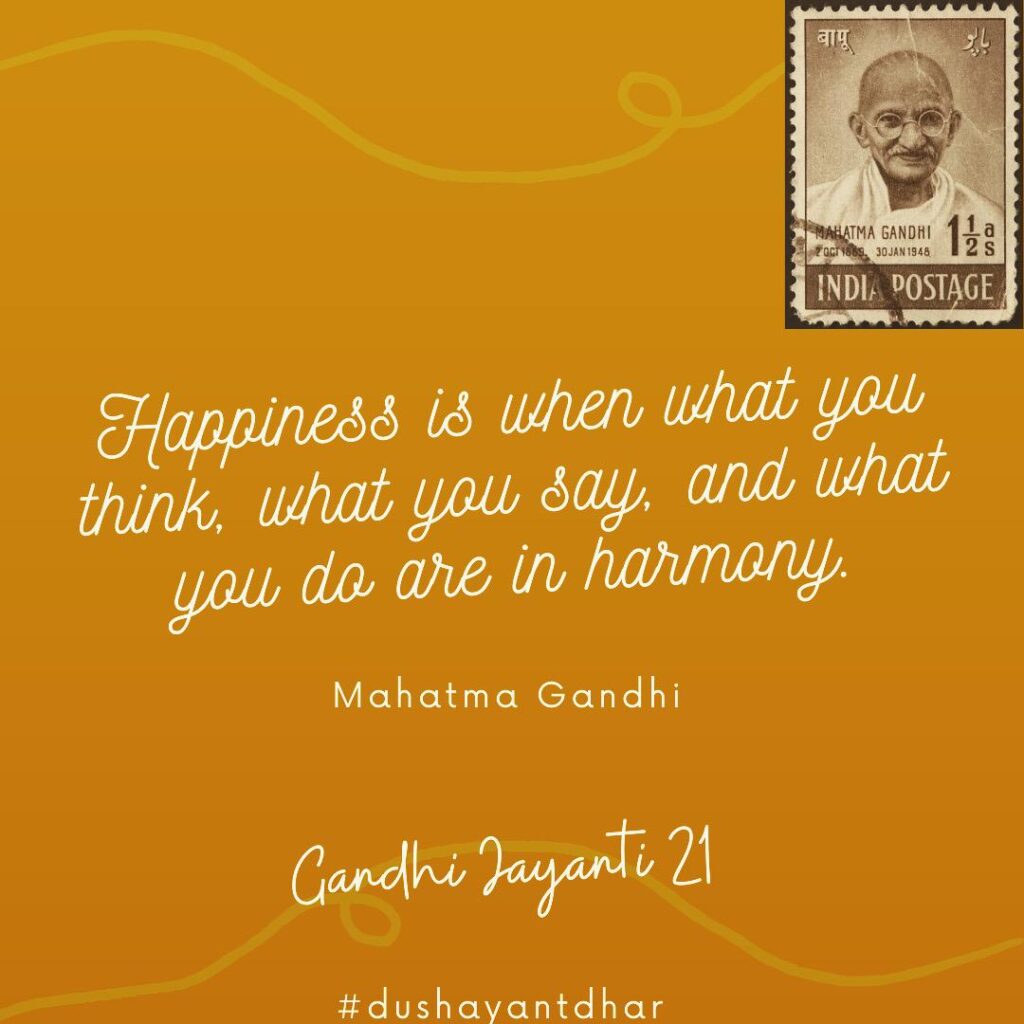
One night towards the end of July 2021, while I was recovering from a hysterectomy and was off work for three months, my husband and I watched the movie titled ‘Gandhi’.
The movie moved me more in my forties than the story as I recall it being told when I attended primary and secondary school in Fiji. The schools were called Mahatma Gandhi Memorial schools, dedicated to the man born as Mohandas Karamchand Gandhi.
Back then, I considered him a patron of our school and a liberator of the people in India, from issues such as the caste system and the British rule. At that time, I had little appreciation for India and her struggles for independence and all the issues fought by Gandhi. All I cared about was Gandhi Jayanti.
In school, every year, on October 02, we would remember the Mahatma, for October 02 is Gandhi Jayanthi – the day he was born. There would be, of course, speeches from the school Principal, and one or two students, as they reflected on the life of Gandhi. There would be some traditional Indian dances and some songs that we all sang. ‘Jay Jawaan, Jay Kisaan’ was one. I still remember some of the words of this song quite well. We would then be given packets of Indian sweets provided by the school, and for the rest of the day, there would be various activities such as debates, quizzes, and sports. We didn’t study at all. The whole day was dedicated to the Mahatma. For me, Gandhi Jayanti was more about these activities rather than the man himself.
And then the movie night happened. His work, his life, his dreams sank deep into my soul. A liberator of his people, in his time, in his own special way. Which made me think of my ancestry.
Now, in all honesty, I have thought about my ancestry many times, often as a passing thought, over many years. I had gone beyond just thinking about it when hubby and I visited Trinidad and Tobago in 2015. Pre-Covid of course! One in two Trinis were Indians, which I had not anticipated…shows my ignorance back then. What had fascinated me about the Indian heritage there was that the local cuisine featured by our hotel resembled some of the dishes that are also are a part of the local Fijian cuisine. I was intrigued.
I then read about the history of Trinidad and found that the Indians there had been brought in by the British in a similar way as the Indians to Fiji – through the “indenture” system. I also learnt that most of the Indians in Trini and Fiji had come from the Indian states of Bihar and Uttar Pradesh. The Trini Indians spoke a language I could not understand, and I surmised that their language had gone through a similar transition process as the Hindi version in Fiji, borrowing many words from both English and indigenous languages.
Anyway, I digress.
After much research, to compensate for, or overcome, my ignorance about the plight of Indians and the other issues that Gandhi fought for, I have come to realise that Indians were not only sent to Fiji and Trinidad and Tobago. They were also sent to other British colonies back then, such as Mauritius, Natal, Guyana, and Jamaica. According to scholars (e.g., Allen, 2008; Mahase, 2008) on the topic of the indenture system, the reason for Britain looking to India to provide labour in the colonies was because the African slavery system had come to an end in 1834. However, work in the colonies, particularly on plantations such as sugar, coffee, tea, rubber, cocoa, and rice, needed to be carried on and cheap labour was essential.
I will not re-write history here on how Indians were misled by local recruiters about the new life that awaited them in the colonies, nor the harsh realities they faced upon arrival in the plantations, nor the hardships of the life left behind in India being equal to the hardships endured in these colonies. Rather, those stories have been told and re-told over the course of history, and my quest here was to find my own history.
Back to the Gandhi movie and the day after…
I spent the entire day lost on the internet…looking at articles and websites that fed my mind with stories of the life of Indians in Uttar Pradesh and Bihar. The languages spoken, the types of food that were prominent, the customs and etiquette, consumed me. It was news to me that these states were located on the plains around the river Ganges, very close to Punjab, West Bengal, and Dehli.
Then I got bored, towards the end of the day, when I had not found much except that some of the staple foods eaten in these states were similar to the food we ate in Fiji, like the chokha, dhal, saijan, and jackfruit. I did not think more about this as I was recovering from my hysterectomy.
But fate had other plans. Ten days later, I dreamt about me being in India, in a village that was situated alongside a river which I referred to as the Ganges in my dream. Have never seen the Ganges in real life! I believe this dream was a result of my mind still processing what I saw in the Gandhi movie and the questions within myself that followed days after. I had started to wonder where my ancestors came from.
Which prompted me to get serious, like super serious, and do some proper research. And thus began a wonderful and fulfilling journey for me. A quest for my identity. I have long held the view that I am Fijian, and that view has not changed after the search for my ancestry.
What has changed is the level of appreciation I now have for the difficulties my ancestors encountered, the decisions they made, the lives they lived…all so I could have my life lived so differently from theirs. Until quite recently, I had never given their plight more than a passing thought, even when I read a few stories of Girmityas in Fiji as part of the required literature for a vernacular class at school.
The word Girmit is another example of a word borrowed from another language and made our own. Indians back then signed an agreement, the indenture contract, for their terms and conditions of work in Fiji. Girmit is derived from the word ‘agreement’. Girmityas are the people who served the Girmit, the set of people which includes my ancestors.
Throughout the two-month journey of researching and putting pieces of the family jigsaw together, I have gone through a roller coaster of emotions. I have sunk to the depths of despair when I encountered dead end after dead end. I have cried for hours on end when I triumphed and got past the dead ends. I have felt gratitude towards the record keepers of the emigration passes, and the registers in Fiji which held details of the Girmityas. I have reflected on the fact that these people meticulously filling out forms probably had no idea at the time that they were indeed writing history when they were penning these records. But above all, I have felt overwhelming joy, pride, and sadness as I found my ancestors and reflected on their journeys.
Without them, there would never have been me. And without Gandhi, the indenture system, which was more like a slavery system in disguise, would not have ended. It is a bittersweet event in history, nonetheless. For while they came as slaves and experienced hardships that I could never possibly fathom, in doing so, they paved the way for future generations to live lives that they never got to live themselves. They left a legacy, for which I am truly grateful.
And the Mahatma – well, he spoke to me from beyond his grave. After all these years, so many years since I attended schools named after him, he inspired me to find my roots. And even though I did not plan any of this, it is quite timely that today, on Gandhi Jayanti, I write this to pay tribute to this great man. Today, I reflect on how the past always has a way of paving one’s future.
In the next post, I will describe how to conduct the search for ancestors. For me, it was all a matter of finding out for the first time how to do such a search. I hope my experiences will help others like me. In the last post in this series, I will share my reflections on the ancestry search journey.